
By 1808Delaware
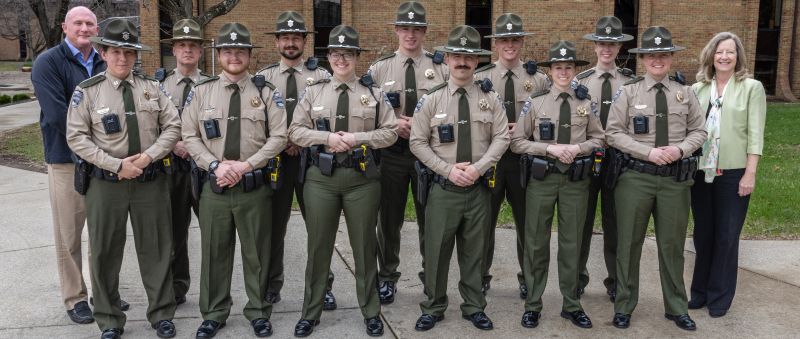
At a recent ceremony in Columbus, nine newly commissioned Natural Resources Officers stepped into roles that extend far beyond traditional law enforcement, marking a milestone not only for the individuals involved but for communities across Ohio.
The commissioning, held at the headquarters of the Ohio Department of Natural Resources, concluded the agency’s tenth Natural Resources Officer Training Academy. Among the new officers is J.P. Wesley of Columbus, who will begin his assignment at Alum Creek State Park, bringing an added presence to one of central Ohio’s most heavily used outdoor destinations.
A Role That Blends Protection and Presence
Natural Resources Officers occupy a unique space in Ohio’s public safety framework. As commissioned peace officers, they are tasked with enforcing laws across state parks, forests, waterways, and nature preserves. But the role carries a broader expectation.
“These nine officers represent the next generation of leadership in Ohio’s outdoors,” said Mary Mertz. Her remarks underscored the dual nature of the position: part law enforcement, part stewardship, and part public-facing guide to the state’s natural assets.
That combination is increasingly important as outdoor recreation continues to grow. Parks and waterways are not just protected spaces. They are active, heavily visited environments where safety, education, and accessibility intersect on a daily basis.
Training for Complexity, Not Routine
The path to becoming a Natural Resources Officer reflects that complexity. The new class began training in August at the Ohio State Highway Patrol Training Academy, completing the same foundational peace officer curriculum required across the state.
From there, the focus shifted. Specialized ODNR instruction added layers specific to the field: vessel operation, ATV use, communications, advanced firearms, and self-defense. The training is designed not for a single type of incident, but for a wide spectrum, from routine patrols to search and rescue operations and disaster response.
“Our Natural Resources Officers wear many hats,” said Glen Cobb. “Law enforcement officer, educator, first responder, and ambassador for Ohio’s natural spaces.”
A Park That Functions Like a Small City
For Delaware County, the assignment of a new officer to Alum Creek carries practical weight because of the park’s scale and constant activity. Centered on a large reservoir just north of Columbus, Alum Creek State Park functions as a regional hub for year-round outdoor recreation. It draws boaters, swimmers, hikers, campers, and families from across central Ohio, often all at once.
The main park area includes day-use amenities such as picnic shelters, playgrounds, grills, and casual sports courts, alongside accessible, family-friendly trails. The park’s beach, stretching roughly 3,000 feet, is one of the largest inland beaches in Ohio, with designated swimming areas, showers, restrooms, and volleyball courts operating through the daytime season.
Elsewhere, the park’s footprint expands into multiple distinct zones. The Africa Road and Galena trail areas offer wide, multi-use paths that are open around the clock and popular with dog owners. The campground off Old State Road supports both tent and RV users with full facilities, while the below-dam recreation area along Lewis Center Road provides 24-hour access for hiking, picnicking, and riverside use. Most parking remains free, though high-demand areas such as the beach can include paid lots during peak use.
Recreation at Scale Requires Oversight
That breadth of activity translates directly into the responsibilities of officers assigned there. On any given day, the role may include enforcing boating regulations on the reservoir, monitoring swimming areas, assisting visitors on trails, or responding to emergencies ranging from medical incidents to severe weather events. The park’s family-oriented design, with multiple playgrounds and picnic spaces, also brings a steady presence of children and group gatherings, adding another layer of responsibility.
Pets are allowed throughout most of the park, including designated dog-friendly trails and areas near the beach, further increasing the need for consistent oversight and public interaction.
In this setting, enforcement is only part of the job. Education, visibility, and approachability are equally central.
A System Moving Toward National Standards
The commissioning arrives at a moment of institutional advancement as well. Both Natural Resources Officers and Wildlife Officers under ODNR recently achieved accreditation through Commission on Accreditation for Law Enforcement Agencies, widely considered the national benchmark for public safety agencies.
The decision to pursue accreditation was voluntary, signaling an effort to align Ohio’s natural resources law enforcement with the highest professional standards in the field.
From Ceremony to Service
While the ceremony marks a formal beginning, the work ahead will be defined in the field. Newly commissioned officers will continue training alongside experienced personnel, translating classroom instruction into real-world application. For visitors at Alum Creek, that transition will be largely seamless. The experience remains the same: a place to swim, hike, camp, and gather.