By 1808Delaware
Delaware’s long-running pursuit of a downtown hotel moved another step forward Monday, with City Council beginning consideration of a land transfer that could clear the way for a project carrying a distinctly local identity.
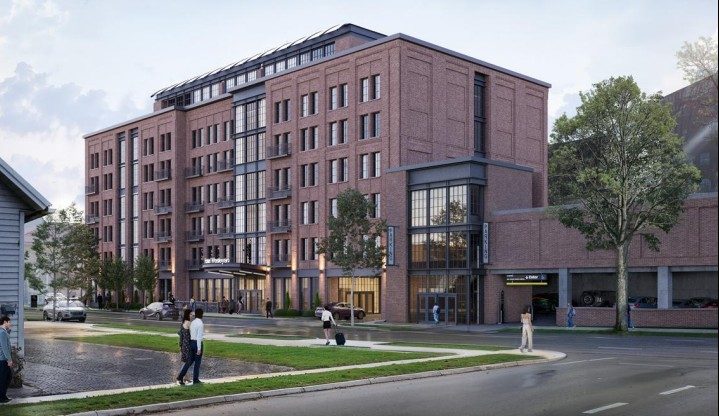
On September 14, Council heard the first reading of an ordinance to transfer a city-owned 0.95-acre property along Spring Street to the Community Improvement Corporation of Delaware County. The property, between South Franklin and South Sandusky streets and now used largely for surface parking, is intended to become part of a new hotel development tentatively known as Hotel Wesleyan.
The proposal is considerably larger than simply adding hotel rooms downtown.
About 100 Rooms and a New Parking Deck
Westwood Collective, the Central Ohio developer selected through the city’s competitive process, has outlined a hotel of approximately 100 rooms accompanied by a parking facility of as many as 280 spaces. Documents submitted to the city say the hotel could ultimately carry either a Marriott Tribute or Hilton Tapestry Collection brand. The overall investment could approach $50 million as the concept is developed, according to Westwood’s submission. Plans remain preliminary, meaning the name, design, financing package and individual components can still change.
Westwood is led by founder and CEO Andy Warnock, a Delaware native and Ohio Wesleyan University graduate whose company has been active in Hilliard, Plain City and London. The company says it has more than 20 years of real estate experience and a portfolio that includes apartments, restaurants, entertainment venues, mixed-use projects and commercial properties.
Ohio Wesleyan Would Be Woven Into the Project
The Wesleyan name would represent more than geography. Westwood’s proposal describes the project as a partnership with Ohio Wesleyan, with university-owned property west of the city site potentially being used for the parking deck. Delaware Economic Development Director Nic Langford told council that the OWU board is actively considering the property arrangement.
The developer has also floated an unusually extensive university connection. Ideas include OWU branding inside the hotel, internships and student employment, a possible hospitality certification program, gallery space tied to the Richard M. Ross Art Museum and a fitness facility incorporating Battling Bishops branding. The lobby could function partly as a coffee shop, study and meeting space, with a baby grand piano available for performing arts students. Those ideas are proposals rather than final commitments.
Hayes, the Little Brown Jug and Downtown Dining
Westwood’s early plans also lean heavily into Delaware history. A proposed restaurant, Boulevard XIX, takes its name from Rutherford B. Hayes, the Delaware native who became the 19th president of the United States. Nearby, the proposed Paddock Lounge would draw its identity from another Delaware institution, the Little Brown Jug, with memorabilia incorporated into the cocktail lounge between the hotel lobby and restaurant.
Two potential ground-floor tenants have already expressed interest, according to the development documents. One is Playa Bowls, the fruit-bowl, smoothie and juice chain. The other is Bishop’s Brew, envisioned as a student-run coffee shop connected with the Delaware Entrepreneurial Center and OWU’s Woltemade Center.
Solar panels are also included among the ideas under consideration for the hotel roof.
Parking Would Serve More Than Hotel Guests
The parking component could become an important piece of the project beyond the hotel itself. Preliminary plans call for a two-story structure with additional rooftop parking. Under the concept presented by Westwood, the ground level would provide public parking, the second level would primarily serve hotel guests, and rooftop spaces would be available to Ohio Wesleyan. That structure would be located farther west along Spring Street on property associated with OWU.
The project still has land-use hurdles ahead. Property involved in the proposed development currently carries both Civic/Institutional and Neighborhood Mixed Commercial zoning, and city documents indicate a planned-unit-development rezoning would be required before construction could proceed.
The City Land Transfer Is Only One Piece
Monday’s council action does not transfer the city property directly to Westwood. Instead, the ordinance would convey it to the Community Improvement Corporation, which acts as an economic development agency and can subsequently transfer the property to the selected developer under an agreement setting conditions for the project. City officials have said that structure avoids the need for the city to simply auction the land to the highest bidder. The city’s original request for proposals contemplated reduced or nominal land pricing as one possible incentive.
Westwood has identified several other potential financing tools, although none has been finalized. They include C-PACE financing for eligible energy-related improvements, tax increment financing or a new community authority to help support the parking structure, and a request for a 15-year, 100% property-tax abatement on improved value. The developer has also suggested raising private investment through Ohio Wesleyan alumni.
One other idea ties the hotel directly to education funding. According to the proposal, OWU President Matt vandenBerg suggested directing hotel bed-tax revenue toward the Delaware County Promise, the university program providing qualifying Delaware County students with tuition-free attendance at OWU.
Deadlines Would Protect the City Property
The proposed land transfer includes provisions designed to keep the property from sitting indefinitely if the hotel stalls. The city would have the right to reclaim the property if a final building permit is not secured and construction has not materially begun within 24 months after the CIC receives the deed. The same right would apply if hotel construction is not substantially completed within 60 months.
Westwood has described Hotel Wesleyan as the first phase of what could become a larger Spring Street redevelopment, potentially bringing additional mixed-use and residential development if adjacent property can be assembled and city support continues.
For now, the next step is back at City Hall. Council is scheduled to hold the ordinance’s second reading and a public hearing on September 28, when city staff is expected to make a more detailed presentation. Staff has recommended approval during the ordinance’s second or third reading.