By 1808Delaware
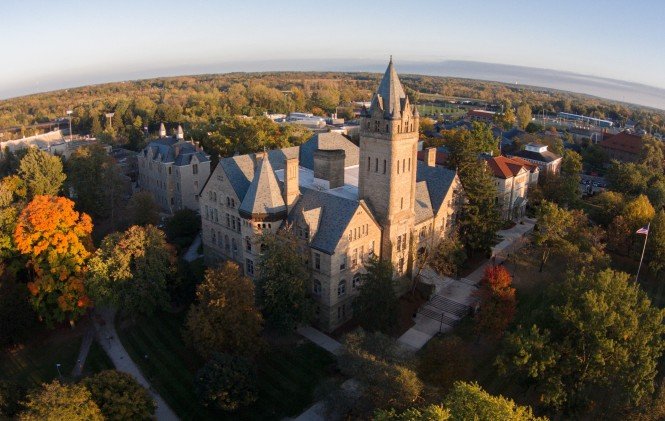
A major shift is coming to Ohio Wesleyan University. Backed by more than $17 million in alumni philanthropy, the Conrades School of Engineering marks the largest academic expansion in the university’s 183-year history. It opens the door for Ohio Wesleyan to welcome its first mechanical engineering majors in fall 2027, signaling a deliberate move to link liberal arts with the technical backbone of a fast-changing regional economy
A Generous Gift
The school carries the name of George Conrades, Class of 1961, and Patricia “Patsy” Belt Conrades, Class of 1963, whose lead gift of $13 million set the project in motion. Their support reflects a belief that Ohio Wesleyan can prepare engineers who bring more than technical skill to the table. They want graduates who can apply creativity, empathy, and sound judgment across industries that now move at a startling pace.
President Matt vandenBerg has framed the launch as a public-facing mission rather than an internal accomplishment. The idea is not just to grow enrollment but to build engineers who can think broadly, communicate well, and lead with a steady hand. Whether the school can hold that balance as it scales is a fair question, and one the university will need to answer through results rather than rhetoric.
The Regional Pressure Behind the Decision
The Columbus region is changing rapidly, driven by advanced manufacturing, semiconductor work, and the companies that feed their supply chains. Jason Hall, CEO of the Columbus Partnership, says the shift has been dramatic. Several years ago, manufacturing-focused companies accounted for about one-third of the region’s economic development pipeline. Now it’s closer to 60 percent.
Those companies keep asking the same question: Where are the engineers?
That pressure is real. For a small liberal arts university to respond at this level is ambitious, and honestly, a little risky. Engineering programs are expensive, competitive, and often slow to build reputation. But Ohio Wesleyan seems aware of that. Instead of constructing a program in isolation, it built partnerships while the idea was still on paper.
Industry at the Table from the Start
Vertiv, a global digital-infrastructure company with a major presence in Delaware, will offer priority interview consideration for its Central Ohio internships. Ansys, part of Synopsys, is opening its simulation tools to Ohio Wesleyan students through the Ansys Academic Program. Those collaborations give the school early credibility and pave the way for students to work with the same tools used in industry.
To be candid, this kind of alignment is unusual for a new engineering program at a liberal arts institution. It suggests Ohio Wesleyan made the case convincingly and that employers see value in engineers who can approach problems through more than a single lens.
Alumni Reinforcement and a Distinct Model
The Conrades gift is joined by $2 million from Doug Dittrick Jr. and Gina Boesch, and another $2 million from Gordon and Helen Smith. George Conrades credits two Ohio Wesleyan professors, Robert Wilson and Howard Maxwell, for steering him toward a career that eventually led to major roles at IBM, BBN, Akamai Technologies, and Oracle. His point is simple: mentoring changed his life, and he believes the next generation will need the same mix of rigor and human connection.
Ohio Wesleyan’s approach hinges on blending mechanical engineering fundamentals with strengths the university already owns: interdisciplinary thinking, close faculty mentorship, and experiential learning through the OWU Connection. Students will work through mechanics, thermodynamics, fluid dynamics, materials science, and design, while also using advanced simulation tools and completing internships.
The curriculum leans heavily on hands-on labs and problem-solving rather than lecture-driven theory. It also builds in what the university calls “power skills,” nine core competencies tied to communication, judgment, collaboration, and adaptability.
This isn’t an easy balance to maintain. The danger is diluting either the engineering rigor or the liberal arts identity. But if the school manages to keep both intact, it may land in a rare space: producing engineers who can not only calculate but also explain, lead, and build trust.
Path to Accreditation
Graduates completing the four-year mechanical engineering program will receive a Bachelor of Science in Mechanical Engineering from a program planning to pursue ABET accreditation. Two minors — Engineering Science and Science & Engineering in the Public Interest — offer entry points for students in other majors who want technical fluency without committing to the full program.
Looking Ahead
The Conrades School of Engineering gives Ohio Wesleyan a chance to influence both education and the region’s workforce in a tangible way. The promise is compelling. The challenge will be execution: faculty hiring, student interest, lab development, and ABET accreditation all require sustained focus. If the university handles those well, this could become one of the more interesting liberal-arts-based engineering experiments in the country.
More information about the school and the mechanical engineering major is available at owu.edu/engineering, and admission details can be found at owu.edu/admission.
Source: OWU; Photo: Ohio Wesleyan President Matt vandenBerg (left) celebrates the announcement of OWU’s Conrades School of Engineering with a selfie including faculty members Hanliang Guo, Brad Trees, Scott Linder, and Matt Vollrath sporting new OWU engineering T-shirts. (Photo by Paul Vernon)